The US lakes landscape is incredibly diverse. The United States is home to enormous freshwater lakes, glacier-carved lakes, mountain lakes, saline lakes, natural inland lakes, and thousands of human-made reservoirs.
Some US lakes are famous around the world, such as Lake Superior, Lake Michigan, Lake Tahoe, Great Salt Lake, and Lake Okeechobee. Others are remote water bodies found in Alaska, Minnesota, Wisconsin, Michigan, and other lake-rich states.
But how many lakes are actually in the United States? Which state has the most lakes? What is the largest lake in the US? And which lakes are completely within the country?
The answer depends partly on how a lake is defined and counted. A USGS study identified about 3.5 million lakes and reservoirs larger than 0.001 square kilometers in the contiguous United States, excluding the Great Lakes. For Alaska, incomplete data suggested approximately 1–2.5 million lakes larger than the same threshold.
That means there is no single universally correct number of “US lakes.” Different sources use different minimum sizes and may or may not include reservoirs.
How Many Lakes Are in the United States?
There is no single official number covering every lake in the United States because researchers use different definitions and datasets.
One of the most useful scientific estimates comes from the USGS. Researchers analyzed complete geospatial data for approximately 3.5 million lakes and reservoirs larger than 0.001 km² in the contiguous United States, excluding the Laurentian Great Lakes.
The same research found that Alaska may contain approximately 1–2.5 million lakes larger than 0.001 km², although the available data for Alaska were incomplete.
This is why websites can report very different numbers when answering how many lakes are in America.
Why Do US Lake Counts Differ?
Lake totals depend on several factors:
- The minimum surface area included
- Whether very small ponds are counted
- Whether reservoirs are included
- Whether the Great Lakes are included
- Which geographic areas are covered
- Which mapping or satellite dataset is used
- How individual water bodies are classified
For example, a database designed to study large lakes will produce a dramatically smaller number than a database that includes tiny water bodies.
The USGS has also published research using a different dataset that identified 102,528 natural lakes and 1,891 reservoirs across the contiguous and other US areas included in that particular analysis.
Therefore, when someone asks for the exact number of US lakes, the most accurate response is: it depends on the definition and size threshold being used.
Which US State Has the Most Lakes?
Alaska has an extraordinary number of lakes, and scientific estimates indicate that it may contain between 1 million and 2.5 million lakes larger than 0.001 km². However, the USGS emphasizes that the available Alaska data are incomplete.
Minnesota is another state strongly associated with lakes. The Minnesota Department of Natural Resources officially lists 11,842 lakes of at least 10 acres.
So the answer depends on the counting threshold.
If extremely small water bodies are included, Alaska’s vast landscape gives it an enormous advantage. If a particular state-based minimum size is used, rankings can look different.
Why Alaska Has So Many Lakes
Alaska’s huge land area, glaciers, mountains, permafrost, and varied geological history have created countless depressions capable of holding water.
Many Alaskan lakes are also remote and difficult to survey, which is one reason estimates can vary.
Why Minnesota Is Called the Land of 10,000 Lakes
Minnesota’s nickname comes from its exceptionally large number of lakes.
However, the state’s official figure is actually higher than 10,000. The Minnesota DNR reports 11,842 lakes that are at least 10 acres in size.
This makes Minnesota one of the best-known lake states in the country.
U.S. Lakes List
The United States has thousands of natural lakes, reservoirs, and other inland water bodies spread across different regions. Some are enormous freshwater lakes, while others are small mountain, forest, or desert lakes.
A useful U.S. lakes list includes:
- Lake Superior
- Lake Michigan
- Lake Huron
- Lake Erie
- Lake Ontario
- Great Salt Lake
- Lake Iliamna
- Lake Oahe
- Lake Okeechobee
- Lake Pontchartrain
- Great Bear Lake is not in the U.S.; it is in Canada
- Lake Champlain
- Lake Tahoe
- Crater Lake
- Flathead Lake
- Yellowstone Lake
- Great Slave Lake is not in the U.S.; it is in Canada
The Great Lakes are especially important because they form one of the world’s largest connected freshwater systems. The five Great Lakes are Superior, Michigan, Huron, Erie, and Ontario, and they are shared by the United States and Canada.
Best Lakes in U.S. to Live On
Living on a lake can offer beautiful scenery, boating, fishing, swimming, and easy access to outdoor recreation. However, the right lake community depends on factors such as housing costs, climate, employment, public access, shoreline regulations, and local services.
Some well-known lake areas to consider include Lake Tahoe, Lake Champlain, Lake Michigan, Lake Okeechobee, Lake Lanier, Lake Norman, Lake Washington, and Flathead Lake.
For people who want mountain scenery, Lake Tahoe and Flathead Lake offer very different landscapes from the large Great Lakes. Those looking for warmer weather may prefer lake communities in the Southeast or South.
When researching a place to live, it is useful to look beyond the view. Property taxes, insurance, flood risk, water quality, shoreline rules, boat access, and year-round community services can make a major difference.
Top 20 Largest Lakes in the US
The answer depends on whether the ranking includes the Great Lakes and whether a lake is ranked by its total surface area or only the portion located inside the United States.
A useful list of major large U.S. lakes and reservoirs includes:
- Lake Superior
- Lake Michigan
- Lake Huron
- Lake Erie
- Lake Ontario
- Great Salt Lake
- Lake Oahe
- Lake Okeechobee
- Lake Sakakawea
- Lake Champlain
- Fort Peck Lake
- Lake Powell
- Lake Mead
- Lake Roosevelt
- Lake Sakakawea
- Flathead Lake
- Lake of the Woods
- Lake Pontchartrain
- Kentucky Lake
- Lake Lanier
The exact order can change depending on whether natural lakes and reservoirs are combined and how interstate or international lakes are measured. USGS data have historically identified hundreds of freshwater lakes in the United States with substantial surface areas, while Alaska contains a particularly large share of the country’s large and deep lakes.
Best Lakes in the U.S. for Swimming

The United States has many lakes suitable for swimming, from large Great Lakes beaches to smaller inland swimming areas.
Popular examples include Lake Michigan, Lake Tahoe, Lake Champlain, Lake George, Lake Chelan, Lake Lanier, Lake Norman, and Lake Havasu.
Swimming conditions can vary considerably between locations on the same lake. Water temperature, currents, algae, bacteria, weather, and local beach conditions can all affect whether swimming is advisable.
Before entering a lake, check local beach advisories and water-quality information. The EPA notes that beaches may be closed or placed under advisories when bacteria levels exceed applicable standards.
Most Gorgeous Lakes in US
The United States has lakes with dramatically different scenery. Some are surrounded by mountains, others by forests, beaches, deserts, or rolling farmland.
Lake Tahoe is famous for its mountain setting and clear-looking water. Crater Lake is known for its deep blue appearance and volcanic surroundings. Flathead Lake combines a large freshwater landscape with mountain views, while Lake Powell is surrounded by the red-rock scenery of the Southwest.
Other visually impressive destinations include Lake Champlain, Lake George, Lake Chelan, Yellowstone Lake, and parts of Lake Michigan.
“Most gorgeous” is naturally subjective, so a better comparison is to consider scenery, water color, mountains, beaches, wildlife, accessibility, and recreational opportunities.
Largest Lake in US Besides Great Lakes
If the five Great Lakes are excluded, Great Salt Lake in Utah is one of the most prominent answers by surface area, although its size changes substantially with water level.
Great Salt Lake is a saline lake rather than a freshwater lake. USGS describes it as the largest lake west of the Mississippi River and documents major changes in its surface area over time.
If the question specifically means the largest freshwater lake entirely within the contiguous United States outside the Great Lakes, the answer differs from the Great Salt Lake because salinity and lake classification matter.
Cleanest US Lakes
There is no single permanent list of the “cleanest U.S. lakes.” Water quality can vary by location, season, weather, runoff, nutrients, bacteria, algae, and other environmental factors.
Lakes such as Lake Tahoe, Crater Lake, Flathead Lake, and Lake George are often discussed for their clear or high-quality water, but readers should distinguish visual clarity from overall water quality.
The EPA’s National Lakes Assessment evaluates multiple aspects of lake condition rather than judging a lake simply by how clear its water looks. Its assessments consider biological, chemical, physical, and recreational conditions.
For swimming or recreation, current local water-quality information is more useful than relying on an old “cleanest lakes” list.
Largest US Lakes by Surface Area
Surface area is one of the most common ways to compare lake size. When the Great Lakes are included, they dominate the upper end of U.S. lake rankings.
The five Great Lakes have enormous combined surface area, with Lake Superior being the largest by surface area. The Great Lakes together cover more than 94,000 square miles and represent the largest surface freshwater system of its kind.
Outside the Great Lakes, major large water bodies include Great Salt Lake, Lake Oahe, Lake Sakakawea, Lake Okeechobee, Fort Peck Lake, and Lake Powell.
It is important to identify whether a list includes reservoirs because reservoirs can rank very high by surface area but are human-made water bodies rather than natural lakes.
Biggest US Lakes
The biggest U.S. lakes include both natural lakes and reservoirs. If the Great Lakes are counted, Lake Superior, Lake Michigan, Lake Huron, Lake Erie, and Lake Ontario occupy the top tier.
Outside the Great Lakes, Great Salt Lake is an especially large natural lake, although its surface area changes with water level. USGS records show that Great Salt Lake has experienced major fluctuations in area and volume.
Large reservoirs such as Lake Oahe, Lake Sakakawea, Fort Peck Lake, Lake Powell, and Lake Mead are also major U.S. water bodies when artificial lakes are included.
Which US Lakes Have the Cleanest, Clearest Water?
Clear water and clean water are not exactly the same thing. A lake may look exceptionally clear while still requiring water-quality monitoring, and a lake with less visual clarity may still meet recreational water-quality standards.
Lake Tahoe and Crater Lake are well-known examples of U.S. lakes associated with exceptional water clarity. Other lakes frequently appreciated for clear-looking water include Flathead Lake and Lake George.
For swimming, readers should check current local monitoring information instead of relying only on photographs or reputation. EPA water-quality data combines information from federal, state, tribal, local, and other monitoring programs.
Deepest US Lakes
The United States has many exceptionally deep lakes, particularly in Alaska and the western mountain states.
Crater Lake in Oregon is the deepest lake in the United States, reaching approximately 1,943 feet at its deepest point. Its great depth comes from its volcanic origin.
Other notably deep U.S. lakes include Lake Tahoe, Lake Chelan, Lake Superior, Lake Pend Oreille, and Lake George.
Alaska also contains many deep lakes. USGS has documented that a large proportion of the country’s very deep lakes are located in Alaska.
Depth and surface area measure different things, so the largest lake is not necessarily the deepest lake.
US Lakes by Size
U.S. lakes can be compared by several measurements, including surface area, maximum depth, volume, shoreline length, and elevation.
For a surface-area list, major examples include:
| Lake | General location | Type |
| Lake Superior | MI, WI, MN / Canada | Natural |
| Lake Michigan | MI, WI, IL, IN | Natural |
| Lake Huron | MI / Canada | Natural |
| Lake Erie | NY, PA, OH / Canada | Natural |
| Lake Ontario | NY / Canada | Natural |
| Great Salt Lake | Utah | Natural, saline |
| Lake Oahe | SD / ND | Reservoir |
| Lake Okeechobee | Florida | Natural |
| Lake Sakakawea | North Dakota | Reservoir |
| Lake Champlain | VT, NY / Canada | Natural |
The ranking changes when reservoirs are excluded or when only lakes entirely inside the United States are counted. That distinction is important for an accurate “US lakes by size” article.
Biggest Lake in the US Besides the Great Lakes
Great Salt Lake is a major candidate when the Great Lakes are excluded, but it should not be confused with a freshwater lake. Its surface area fluctuates with water levels, and it is a saline lake in Utah.
For readers specifically searching for the largest freshwater lake outside the Great Lakes, the answer depends on whether the lake must be entirely within the contiguous United States and whether reservoirs are included.
This is why a strong lake-size article should always state its measurement rules before presenting a ranking.
10 Biggest Lakes in USA
A practical list of 10 major U.S. lakes and large reservoirs is:
- Lake Superior
- Lake Michigan
- Lake Huron
- Lake Erie
- Lake Ontario
- Great Salt Lake
- Lake Oahe
- Lake Sakakawea
- Lake Okeechobee
- Fort Peck Lake
The exact ranking can differ depending on whether the list uses total lake area, U.S.-only area, natural lakes only, or natural lakes plus reservoirs.
The five Great Lakes are especially significant because they are enormous freshwater bodies shared between the United States and Canada.
American Lakes List
An American lakes list can include famous lakes from every major region of the country:
- Lake Superior
- Lake Michigan
- Lake Huron
- Lake Erie
- Lake Ontario
- Lake Tahoe
- Crater Lake
- Great Salt Lake
- Lake Champlain
- Lake Okeechobee
- Flathead Lake
- Lake George
- Lake Chelan
- Lake Powell
- Lake Mead
- Lake Lanier
- Lake Norman
- Yellowstone Lake
- Lake Pontchartrain
- Lake Winnipesaukee
These lakes represent a wide range of landscapes, including mountain, volcanic, freshwater, saline, coastal, forest, and reservoir environments.
Salt Water Lakes in the US
The United States has several saline or saltwater lakes, although most well-known American lakes are freshwater.
Great Salt Lake in Utah is the country’s most famous saline lake. Its water contains much more dissolved salt than ordinary freshwater lakes, and its salinity changes with water level and other environmental conditions.
Other saline or highly mineralized water bodies exist in the western United States. The Salton Sea in California is another important example of a saline inland water body. USGS notes that the Salton Sea has become increasingly hypersaline as freshwater inflows have declined.
The term “salt water lake” can therefore refer to different levels of salinity, so an article should distinguish saline lakes from ordinary freshwater lakes.
Biggest Lake in America
“Biggest lake in America” can mean several different things. If the question refers to the largest Great Lake by surface area, Lake Superior is the answer. It is shared by the United States and Canada.
If the Great Lakes are excluded, Great Salt Lake is one of the largest natural lakes in the United States by surface area, but its size fluctuates considerably and its water is saline.
If the question means the largest lake located completely within the United States and specifically wants freshwater, the definition becomes more important. A good comparison should therefore state whether international lakes, saline lakes, and reservoirs are included.
What Is the Largest Lake in the United States?
The answer depends on what “largest” means.
If the Great Lakes are included, Lake Superior is the largest lake associated with the United States by surface area.
If you mean the largest Great Lake located entirely within US territory, the answer is Lake Michigan.
If you exclude the Great Lakes altogether, the ranking changes again because several large lakes are located entirely in the US while others cross international borders.
Historical USGS data show Lake Superior, Lake Huron, Lake Michigan, Lake Erie, and Lake Ontario at the top of US large-lake rankings, followed by lakes such as Lake of the Woods, Iliamna Lake, Great Salt Lake, and Lake Okeechobee.
Largest Major US Lakes by Surface Area
| Lake | Approximate surface area | Location |
| Lake Superior | 31,820 sq mi | US & Canada |
| Lake Huron | 23,010 sq mi | US & Canada |
| Lake Michigan | 22,400 sq mi | United States |
| Lake Erie | 9,940 sq mi | US & Canada |
| Lake Ontario | 7,540 sq mi | US & Canada |
| Lake of the Woods | 1,485 sq mi | US & Canada |
| Iliamna Lake | 1,150 sq mi | Alaska |
| Great Salt Lake | Variable | Utah |
| Lake Okeechobee | 681 sq mi in historical USGS ranking | Florida |
| Lake Pontchartrain | 625 sq mi | Louisiana |
These figures illustrate why it is important to specify the definition and date of a ranking. Some lakes, particularly saline lakes such as Great Salt Lake, can change considerably in surface area as water levels rise and fall.
The Five Great Lakes
The Great Lakes are the most famous group of US lakes and include:
- Lake Superior
- Lake Michigan
- Lake Huron
- Lake Erie
- Lake Ontario
Together, the Great Lakes form the largest surface freshwater system in the world. USGS describes them as covering more than 94,250 square miles (244,106 square kilometers).
NOAA reports that the Great Lakes account for approximately 21% of the world’s surface freshwater, and more than 30 million people rely on them for drinking water.
The Great Lakes also support transportation, fishing, tourism, recreation, wildlife habitat, and regional economies.
1. Lake Superior
Lake Superior is the largest of the five Great Lakes.
It borders:
- Minnesota
- Wisconsin
- Michigan
- Ontario, Canada
It is known for its enormous size, cold water, rocky shoreline, forests, storms, and rugged landscapes.
Lake Superior also stores more water than any other Great Lake. USGS estimates its storage at approximately 2,900 cubic miles, greater than the combined storage of the other four Great Lakes in the cited analysis.
2. Lake Michigan
Lake Michigan is unique among the Great Lakes because it is entirely within the United States.
Its shoreline includes:
- Michigan
- Wisconsin
- Illinois
- Indiana
Lake Michigan is important for drinking water, shipping, recreation, fisheries, beaches, tourism, and regional climate.
It also helped shape the development of major Midwestern cities, particularly Chicago and Milwaukee.
3. Lake Huron
Lake Huron borders Michigan and Ontario.
It includes Georgian Bay and numerous islands and has an extensive shoreline.
Lake Huron is particularly well known for boating, fishing, beaches, tourism, and its large number of islands.
4. Lake Erie
Lake Erie is the shallowest of the five Great Lakes.
It borders:
- Michigan
- Ohio
- Pennsylvania
- New York
- Ontario, Canada
Its relatively shallow waters make it especially responsive to changes in weather and seasonal conditions.
Lake Erie is also important for commercial and recreational fishing, shipping, agriculture, tourism, and drinking-water supplies.
5. Lake Ontario
Lake Ontario is the smallest of the five Great Lakes by surface area.
It borders New York and Ontario.
Despite being the smallest Great Lake, it remains an important freshwater resource and supports major communities, transportation routes, recreation, and wildlife.
Why Are the Great Lakes So Important?
The Great Lakes are not simply large bodies of water. They are critical environmental and economic resources.
According to NOAA, more than 30 million people depend on the Great Lakes for drinking water. The US Great Lakes maritime economy supports approximately 311,000 jobs and generates around $8.8 billion in wages.
The lakes support:
- Drinking-water supplies
- Commercial shipping
- Tourism
- Recreational boating
- Fishing
- Wildlife
- Agriculture
- Industry
- Coastal communities
- Scientific research
USGS also identifies the Great Lakes as important for transportation, irrigation, recreation, and wildlife habitat.
Famous Lakes in the United States
The US has many important lakes beyond the Great Lakes.
Lake Tahoe
Lake Tahoe is located on the California-Nevada border in the Sierra Nevada.
It is famous for:
- Clear water
- Mountain scenery
- Ski resorts
- Hiking
- Boating
- Beaches
- Tourism
Its high-elevation setting makes it very different from the Great Lakes and lowland lakes of the Midwest.
Great Salt Lake
The Great Salt Lake in Utah is one of the most unusual major lakes in the United States.
It is a saline, terminal lake, meaning it has no outlet to the ocean. Water enters the lake but ultimately leaves mainly through evaporation.
Its surface area changes considerably depending on water level.
USGS notes that at an elevation of 4,200 feet, around its historical average, the lake covered approximately 1,700 square miles.
The lake’s salt concentration and water level make it very different from freshwater lakes such as Lake Michigan or Lake Tahoe.
Lake Okeechobee
Lake Okeechobee is Florida’s largest lake and one of the country’s most important shallow freshwater lakes.
USGS describes it as the second-largest freshwater lake entirely within the United States, covering approximately 1,732 square kilometers in the cited study. Its maximum depth is less than about 6 meters.
The lake is important to Florida’s water-management system and surrounding ecosystems.
Flathead Lake
Flathead Lake is located in northwestern Montana.
It is known for:
- Mountain views
- Clear water
- Boating
- Fishing
- Camping
- Wildlife
- Scenic tourism
The surrounding Flathead Valley and nearby mountains make it one of the most scenic lake destinations in the United States.
Lake Champlain
Lake Champlain is located primarily between New York and Vermont, with part of the lake extending into Quebec, Canada.
It is an important freshwater system in the northeastern United States and is known for boating, fishing, wildlife, history, and tourism.
Lake of the Woods
Lake of the Woods lies along the border of Minnesota and Canada.
Its large surface area places it among the major lakes associated with the United States, although it is shared internationally.
US Lakes by State
Lakes occur throughout the United States, but some states are particularly well known for their lake abundance or major water bodies.
Alaska
Alaska is arguably the country’s most remarkable lake state in terms of sheer number.
USGS estimates that Alaska may contain 1–2.5 million lakes larger than 0.001 km², although the estimate is based on incomplete data.
The state’s lakes range from small remote ponds to enormous lakes such as Iliamna Lake.
Minnesota
Minnesota is one of America’s most famous lake states.
The Minnesota DNR reports:
- 11,842 lakes of at least 10 acres
- 6,564 natural rivers and streams
- Approximately 69,200 miles of natural rivers and streams
Well-known Minnesota lakes include:
- Lake Superior
- Mille Lacs Lake
- Lake Minnetonka
- Leech Lake
- Lake Vermilion
- Lake Winnibigoshish
- Lake of the Woods
- Red Lake
Wisconsin
Wisconsin contains thousands of lakes and is particularly well known for boating, fishing, cabins, and outdoor recreation.
The state’s lake regions attract visitors throughout the year.
Michigan
Michigan is surrounded by four Great Lakes and also contains numerous inland lakes.
Its geography gives the state an exceptionally large amount of freshwater shoreline.
New York
New York contains several major lakes, including Lake Ontario, Lake Erie, Lake Champlain, and the Finger Lakes.
The Finger Lakes are a particularly distinctive group of long, narrow lakes in central New York.
Florida
Florida contains numerous natural lakes, wetlands, and reservoirs.
Lake Okeechobee is the state’s largest and most important major lake.
Utah
Utah is best known for Great Salt Lake, one of the largest saline lakes in North America.
Unlike a typical freshwater lake, its water chemistry is heavily influenced by evaporation and the minerals carried into its closed basin.
Montana
Montana contains many mountain and valley lakes, including Flathead Lake.
Its lakes are closely associated with the state’s mountain landscapes and outdoor recreation economy.
Natural Lakes vs. Reservoirs in the United States
One of the most important things to understand about US lake statistics is that a natural lake and a reservoir are not the same thing.
What Is a Natural Lake?
A natural lake forms through geological or natural processes.
Examples of lake-forming processes include:
- Glacial activity
- Tectonic movement
- Volcanic activity
- Landslides
- River changes
- Natural depressions
- Coastal processes
Many lakes in the northern US were strongly influenced by past glaciation.
What Is a Reservoir?
A reservoir is generally a human-created or human-controlled body of stored water, often created by building a dam across a river or valley.
Reservoirs are commonly used for:
- Drinking water
- Irrigation
- Flood control
- Hydroelectric power
- Industrial water supplies
- Recreation
Some databases combine lakes and reservoirs, while others separate them.
That distinction can significantly change statistics.
Why Does the United States Have So Many Lakes?
One of the biggest reasons is glaciation.
During past ice ages, enormous glaciers covered much of northern North America.
As glaciers advanced and retreated, they:
- Scraped and reshaped the landscape.
- Created depressions in the ground.
- Changed drainage patterns.
- Left behind sediment and geological formations.
- Allowed water to accumulate in newly formed basins.
When the climate warmed and the glaciers retreated, many of these depressions became lakes.
This history helps explain the extraordinary concentration of lakes in places such as Minnesota, Wisconsin, Michigan, and parts of New York.
However, glaciation is not the only explanation.
US lakes also formed through:
- Tectonic processes
- Volcanic processes
- River activity
- Landslides
- Coastal processes
- Human engineering
This is why lakes across the country can look and behave so differently.
Are All US Lakes Freshwater?
No.
Many famous US lakes are freshwater, but the country also has saline and hypersaline water bodies.
The Great Salt Lake is the best-known example.
The lake is a closed basin with no outlet to the sea. Water enters primarily through rivers, precipitation, and groundwater, while evaporation removes water and leaves dissolved minerals behind.
The Salton Sea in California is another unusual saline lake.
These lakes demonstrate why the term “lake” does not automatically mean freshwater.
Why Are US Lakes Important?
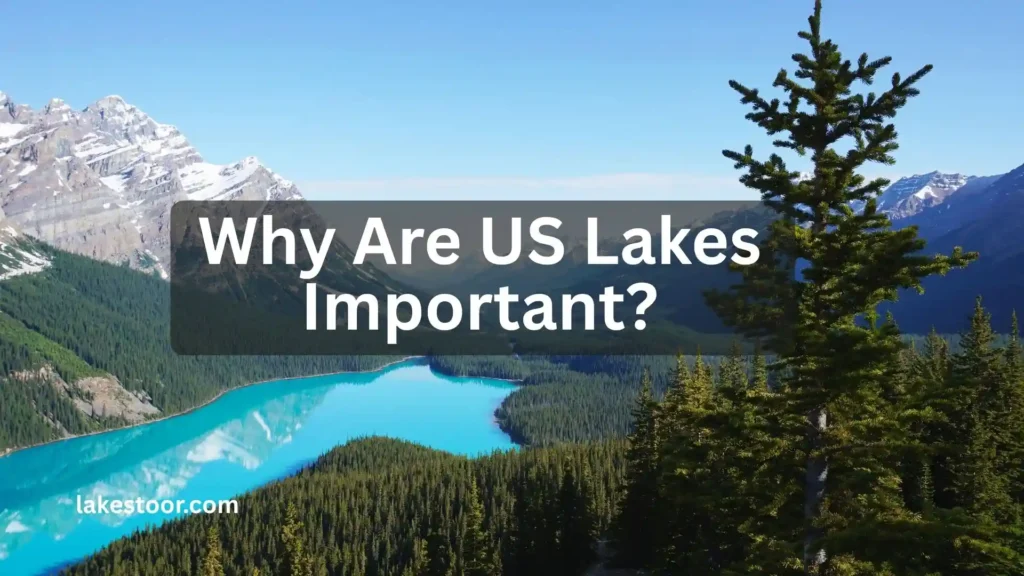
US lakes play major environmental, economic, recreational, and social roles.
Drinking Water
Many communities obtain drinking water from lakes and reservoirs.
The Great Lakes are particularly significant, supplying drinking water to more than 30 million people.
Wildlife Habitat
Lakes provide habitats for:
- Fish
- Waterfowl
- Amphibians
- Reptiles
- Mammals
- Aquatic plants
- Invertebrates
Large lakes can also provide important stopover and breeding areas for migratory birds.
Fishing
Fishing is one of the most popular activities around US lakes.
Depending on the region, anglers may target:
- Bass
- Trout
- Walleye
- Pike
- Perch
- Salmon
- Catfish
The species found in a lake depend on water temperature, depth, habitat, geography, and water chemistry.
Boating and Water Sports
US lakes support many recreational activities, including:
- Kayaking
- Canoeing
- Sailing
- Swimming
- Paddleboarding
- Water skiing
- Fishing
- Motor boating
Mountain lakes and large inland lakes are particularly popular destinations for summer recreation.
Tourism
Lakes contribute significantly to tourism.
Lake destinations often attract visitors for:
- Scenic views
- Beaches
- Camping
- Hiking
- Fishing
- Boating
- Wildlife watching
- Photography
- Winter recreation
Economic Activity
The Great Lakes demonstrate the enormous economic importance of major US lakes.
NOAA reports that the US Great Lakes maritime economy supports about 311,000 jobs and produces approximately $8.8 billion in wages.
Environmental Challenges Facing US Lakes
US lakes face several environmental pressures.
Invasive Species
Non-native species can disrupt aquatic food webs and compete with native organisms.
The Great Lakes, for example, have experienced major ecological challenges related to invasive species.
Nutrient Pollution
Excess nutrients such as phosphorus and nitrogen can contribute to harmful algal blooms.
These blooms can reduce water quality and create problems for wildlife, recreation, and drinking-water systems.
Climate Change
Changing temperatures and precipitation patterns can affect:
- Lake levels
- Water temperature
- Evaporation
- Ice cover
- Water quality
- Aquatic ecosystems
Lake-level changes are particularly important in large systems such as the Great Lakes and Great Salt Lake.
Water Use and Development
Growing populations, agriculture, industry, and development can place additional pressure on lake ecosystems.
Protecting lake watersheds is therefore an important part of maintaining healthy lakes.
Why Great Salt Lake Is Different From Most US Lakes
Great Salt Lake deserves special attention because its water level can change dramatically.
USGS reports that the lake reached a historical high in 1986 and a record-low surface elevation in 2022. Its area changes substantially as the lake rises and falls.
This means a statement such as “Great Salt Lake is X square miles” should ideally include the measurement date or water-level context.
That is an important lesson when comparing US lakes: lake size is not always a fixed number.
What Are the Largest Lakes Entirely Within the United States?
This question is different from asking which lakes are largest in North America.
The Great Lakes are international except for Lake Michigan.
Among major lakes entirely within US territory, Lake Michigan is the largest Great Lake. Other important large US-only lakes include Lake Iliamna in Alaska, Lake Okeechobee in Florida, and other large inland lakes.
Lake Okeechobee is particularly notable because USGS identifies it as the second-largest freshwater lake entirely within the United States in the cited study.
The exact ranking can vary depending on whether the comparison includes saline lakes, reservoirs, changing lake levels, or different measurement methods.
US Lakes vs. Great Lakes: What Is the Difference?
“US lakes” is a broad term covering thousands or millions of water bodies, depending on the definition.
The Great Lakes are a specific group of five enormous interconnected freshwater lakes:
- Superior
- Michigan
- Huron
- Erie
- Ontario
Therefore, the Great Lakes are part of the broader US lakes category, but most US lakes are not Great Lakes.
Frequently Asked Questions About US Lakes
How many lakes are in the US?
There is no single universal total. A USGS study identified about 3.5 million lakes and reservoirs larger than 0.001 km² in the contiguous United States, excluding the Great Lakes. It estimated another 1–2.5 million lakes above the same threshold in Alaska using incomplete data.
Which US state has the most lakes?
Alaska has an extraordinary number of lakes and may contain between 1 million and 2.5 million lakes larger than 0.001 km², according to incomplete USGS data.
Which state is known as the Land of 10,000 Lakes?
Minnesota is known as the Land of 10,000 Lakes. The Minnesota DNR actually reports 11,842 lakes of at least 10 acres.
What is the largest lake in the US?
Lake Superior is the largest lake associated with the United States by surface area. It is shared by the US and Canada.
What is the largest lake entirely within the US?
Lake Michigan is the largest of the Great Lakes that lies entirely within the United States.
What are the five Great Lakes?
The five Great Lakes are Lake Superior, Lake Michigan, Lake Huron, Lake Erie, and Lake Ontario.
Which Great Lake is entirely in the US?
Lake Michigan is the only Great Lake located entirely within the United States.
Is Great Salt Lake freshwater?
No. Great Salt Lake is a saline lake. It is a closed basin in Utah and has no outlet to the sea.
Is Lake Okeechobee a freshwater lake?
Yes. Lake Okeechobee is a large, shallow freshwater lake in Florida. USGS describes it as the second-largest freshwater lake entirely within the United States in the cited analysis.
Why are there so many lakes in Minnesota?
Minnesota’s landscape was heavily influenced by glacial activity, which created numerous depressions that later filled with water.
Are reservoirs considered lakes?
It depends on the dataset. Some scientific databases analyze lakes and reservoirs together, while others distinguish natural lakes from human-made reservoirs.
Are all large US lakes natural?
No. The United States contains both natural lakes and human-made reservoirs.
Why do different websites give different numbers of US lakes?
Different sources use different definitions, minimum lake sizes, geographic boundaries, and datasets. Some include reservoirs and very small water bodies, while others do not.
Bottom Line: Understanding US Lakes
The US lakes landscape is much more complex than a simple list of famous water bodies.
The United States contains an extraordinary number of lakes, ranging from enormous international freshwater systems to tiny remote ponds. The exact number depends on the size threshold, geographic area, and definition used.
The most important points to remember are:
- Lake Superior is the largest Great Lake and the largest lake associated with the United States by surface area.
- Lake Michigan is the only Great Lake located entirely within the US.
- Alaska contains an extraordinary number of lakes, with USGS estimates ranging from 1–2.5 million above a specified small-size threshold, based on incomplete data.
- Minnesota officially counts 11,842 lakes of at least 10 acres.
- The Great Lakes contain approximately 21% of the world’s surface freshwater and provide drinking water to more than 30 million people.
- Great Salt Lake is a major saline lake whose size changes considerably with water levels.
- Lake Okeechobee is one of the largest freshwater lakes entirely within the United States.
- US lake statistics can differ substantially because researchers use different definitions and datasets.
- US lakes are important for drinking water, wildlife, fishing, recreation, transportation, tourism, and regional economies.
Ultimately, there is no single statistic that captures the full diversity of US lakes. From the immense Great Lakes to Alaska’s countless remote water bodies and Minnesota’s thousands of inland lakes, these waterways are one of the defining features of the country’s geography and natural environment.

Hi, I’m Henry Ashford, a writer with a lifelong interest in lakes, landscapes, and the natural environment. I love exploring how lakes influence wildlife, local communities, tourism, and history. My goal is to create informative content that encourages readers to appreciate and protect freshwater environments.
Every article I write is based on careful research and presented in a straightforward, engaging style that makes learning enjoyable.
Books I’ve Written:
- Discovering the World’s Great Lakes
- Freshwater Landscapes: Stories from Around the Globe
 Charlotte Pembroke