If you are searching for which country has the most lakes, the answer is Canada. Canada has more than 2 million lakes, according to Natural Resources Canada, making it the country with the greatest number of lakes in the world. A 2026 statement from the Canada Water Agency also confirms that Canada has over 2 million lakes—more than any other country.
But there is an important detail: the exact number of lakes depends on how a “lake” is defined and counted. Some sources count very small water bodies, while others use minimum size thresholds. That is why you may see different figures when researching Canada’s lakes.
This guide explains which country has the most lakes, how many lakes Canada has, why Canada has so many, which countries come next, and what makes Canada’s lakes unique.
Which Country Has the Most Lakes?
Canada has the most lakes of any country in the world.
Natural Resources Canada says the country is covered by as many as 2 million lakes. More recently, the Canada Water Agency described Canada as having over 2 million lakes, more than any other country.
Canada is also exceptional when lakes are measured by their total area. The Government of Canada reports that Canada has more lake area than any other country and has 563 lakes larger than 100 square kilometres.
Quick answer
| Question | Answer |
| Country with the most lakes | Canada |
| Approximate number of lakes | More than 2 million |
| Lakes over 100 km² | 563 |
| Country known for the greatest lake area | Canada |
| Major lake systems | Great Lakes and numerous Canadian lake networks |
The number should be treated as an estimate rather than an exact count because different surveys and definitions can produce different totals.
Why Does Canada Have So Many Lakes?
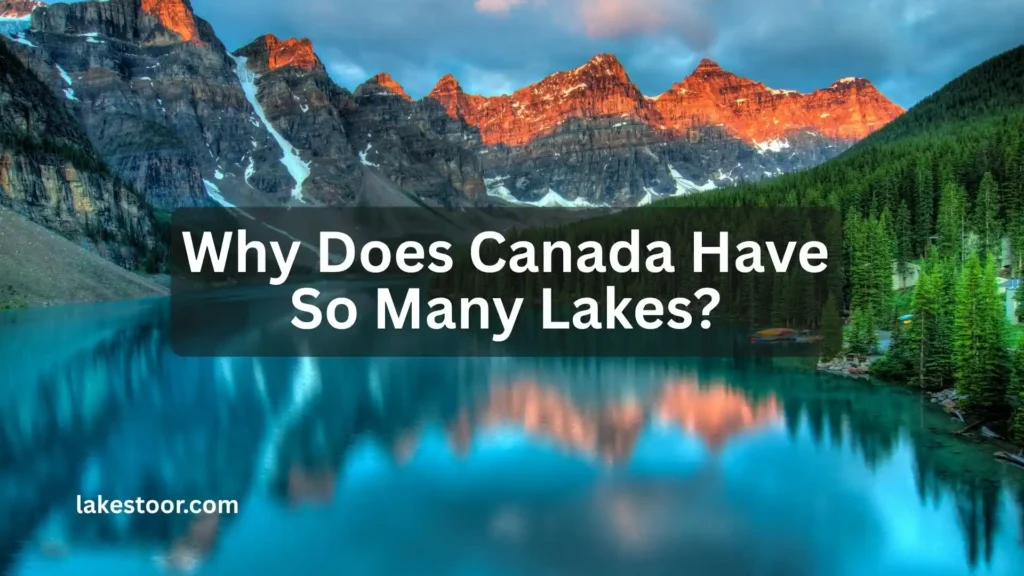
Canada’s enormous number of lakes is largely connected to its geological history and the effects of glaciers.
During the last Ice Age, enormous ice sheets covered much of what is now Canada. As these glaciers moved across the landscape, they eroded rock and created depressions. When the ice eventually melted, many of those depressions filled with water and became lakes.
Canada also has extensive areas of exposed rock, wetlands, rivers, forests, and relatively low-lying terrain that support the formation and persistence of lakes.
Glaciers played a major role
Glacial activity is one of the biggest reasons Canada’s landscape contains so many lakes.
Moving ice could:
- carve valleys and basins
- deepen existing depressions
- transport and deposit sediment
- reshape drainage systems
- leave depressions that later filled with meltwater
The result is a landscape containing countless lakes of different sizes, from small ponds and remote mountain lakes to enormous freshwater bodies.
Which Country Has the Most Lakes in Europe
When lake counts are compared using a consistent minimum-size threshold, Sweden is one of Europe’s leading countries by number of mapped lakes. A global HydroLAKES-based dataset counts about 22,576 lakes in Sweden at or above 0.1 km². Finland is also extremely lake-rich, with about 7,898 lakes under the same threshold.
However, Finland is famous for its much broader national count of 187,888 lakes and ponds larger than 500 square meters. This difference shows why European lake rankings can change depending on the size of water bodies included.
For an SEO article, it is better to state the measurement before presenting a country as having “the most lakes.”
Top 10 Countries With Most Lakes
Using the HydroLAKES-based dataset and a minimum surface area of 0.1 km², the top 10 countries by number of lakes are:
| Rank | Country | Approx. lakes |
| 1 | Canada | 879,763 |
| 2 | Russia | 201,240 |
| 3 | United States | 102,519 |
| 4 | China | 23,751 |
| 5 | Sweden | 22,576 |
| 6 | Brazil | 20,936 |
| 7 | Norway | 20,006 |
| 8 | Argentina | 13,612 |
| 9 | Kazakhstan | 12,429 |
| 10 | Australia | 11,437 |
Canada’s total is particularly striking: this dataset contains about 1.42 million lakes worldwide, and Canada accounts for roughly 62% of them under this definition.
Which Country Has the Most Lakes in Asia
Among Asian countries, Russia has the largest number of lakes in the HydroLAKES-based global comparison, with approximately 201,240 lakes meeting the 0.1 km² threshold. China follows with about 23,751, while Kazakhstan has approximately 12,429.
Russia’s enormous northern territory contains extensive lake landscapes, particularly in Siberia. Glacial activity and other geological processes have contributed to the formation of many of the region’s lakes.
China also contains a wide range of lake environments, from large freshwater lakes to high-altitude lakes on the Tibetan Plateau.
Top 20 Countries With Most Lakes
A useful global comparison needs to specify the dataset and minimum lake size. The recent HydroLAKES-based ranking clearly identifies the leading countries, but published summaries do not provide a verified 20-country table in the same source. The most consistently reported leading group is:
- Canada — 879,763
- Russia — 201,240
- United States — 102,519
- China — 23,751
- Sweden — 22,576
- Brazil — 20,936
- Norway — 20,006
- Argentina — 13,612
- Kazakhstan — 12,429
- Australia — 11,437
- India — 10,812
- Finland — 7,898
- Chile — 5,571
- Ukraine — 4,915
- Poland — 3,717
Because lake databases classify water bodies differently, extending this into a “top 20” without the remaining dataset would risk presenting an unreliable ranking. The figures above are therefore best used with the stated 0.1 km² HydroLAKES threshold.
Which Country Has the Most Lakes Per Square Mile
The answer depends heavily on how a lake is defined and how small a water body is included.
Finland is frequently cited as one of the countries with the highest lake density, largely because it has an enormous number of small lakes and ponds relative to its land area. Finland’s official figure of 187,888 water bodies larger than 500 square meters illustrates this high concentration.
Canada, by contrast, has the world’s largest overall lake count under the 0.1 km² HydroLAKES threshold, but it is also a huge country. Therefore, total lake count and lakes per square mile are different measurements.
This distinction is important when answering searches such as “most lakes per square mile,” because changing the minimum lake size can substantially change the result.
Which Country Has the Most Lakes in Africa
Older World Lakes Network data summarized by the United Nations Environment Programme identifies Uganda as having the highest number of lakes in Africa, with 69 lakes, followed by Kenya with 64 and Cameroon with 59.
The same dataset lists Tanzania with 49 lakes and Ethiopia with 46.
Africa’s lake geography is strongly influenced by the East African Rift System, which contains major lakes such as Lake Victoria, Lake Tanganyika, Lake Malawi, and numerous smaller Rift Valley lakes.
Because lake inventories differ by definition, the figure of 69 should be presented as a result from that specific dataset rather than as a timeless count of every natural lake in Uganda.
Which Country Has the Most Lakes Per Capita
There is no single universally accepted global ranking for lakes per capita because both lake counts and population figures can vary by definition and year.
Finland is often highlighted because its national inventory includes 187,888 lakes and ponds larger than 500 square meters, while its population is relatively small compared with countries such as Canada, Russia, or the United States.
Canada also has an extraordinary number of lakes. A recent Canadian government report estimates more than 875,000 lakes larger than 0.1 km², meaning its lake-to-population ratio is also unusually high.
For a precise “lakes per capita” comparison, the safest approach is to use the same lake-size threshold and the same population year for every country.
Which Country Has the Most Lakes by Area
If the question means total surface area covered by lakes and inland water, Canada is the leading country in commonly cited global geographic datasets.
Statistics Canada states that Canada has more lake area than any other country in the world and has 563 lakes larger than 100 km².
This is different from asking which country has the most individual lakes. Canada stands out on both measures, but the numbers should not be confused.
A country can have many small lakes while another has fewer but much larger lakes. Comparing total lake area therefore provides a different picture from simply counting individual water bodies.
Which Country Has the Most Lakes Canada
Canada is widely recognized as the country with the largest number of lakes when comparable lake-size criteria are used.
The 2026 Government of Canada climate report states that Canada has more than 875,000 lakes with a surface area greater than 0.1 km², representing approximately 62% of the world’s lakes by number under that definition.
A HydroLAKES-based analysis gives a closely related figure of 879,763 lakes for Canada.
Canada’s abundance of lakes is closely connected to its geological history. Large areas of the country were heavily shaped by glaciers during past ice ages, leaving countless depressions that later filled with water.
Biggest Lake in Canada
The biggest lake located entirely within Canada is Great Bear Lake, in the Northwest Territories.
The Government of Canada lists Great Bear Lake at approximately 31,400 km², with the figure rounded and including islands.
Great Bear Lake is also one of the largest freshwater lakes in the world. The European Space Agency describes its area as approximately 31,328 km² and identifies it as the largest freshwater lake entirely within Canadian borders.
There is an important distinction here: Lake Superior is larger overall, but it is shared by Canada and the United States. Great Bear Lake is the largest lake wholly inside Canada.
Countries With Most Lakes
Countries with very large numbers of lakes include Canada, Russia, the United States, China, Sweden, Brazil, Norway, Argentina, Kazakhstan, and Australia.
Under the 0.1 km² HydroLAKES threshold, Canada has approximately 879,763 lakes, Russia about 201,240, and the United States about 102,519.
The distribution is not random. Many lake-rich countries are located in regions that experienced extensive glaciation, particularly across northern North America and northern Eurasia.
The exact ranking can change when smaller ponds, reservoirs, seasonal water bodies, or different mapping criteria are included.
Province With Most Lakes in Canada
Quebec and Ontario are among Canada’s most lake-rich provinces, while Canada’s northern territories also contain enormous numbers of lakes.
Statistics Canada reports that Quebec has approximately 176,928 km² of freshwater area, followed by the Northwest Territories with 163,021 km² and Ontario with 158,654 km².
However, freshwater area is not the same as number of individual lakes. A province can have a huge amount of water because it contains several large lakes, while another may have more individual small lakes.
For that reason, a definitive “province with the most lakes” answer should specify the lake-count database and minimum size being used.
Government of Canada Most Lakes in the World
The Government of Canada provides strong evidence for Canada’s global importance as a lake-rich country.
Canada’s 2026 climate report states that the country has more than 875,000 lakes larger than 0.1 km², accounting for approximately 62% of the world’s lakes by number under that measurement.
Statistics Canada also reports that Canada has 563 lakes larger than 100 km² and more lake area than any other country.
These government figures are especially useful for an informational article because they make the measurement clear instead of simply repeating an unsupported “millions of lakes” claim.
Population+Lakes
Comparing population + lakes can reveal a very different picture from simply counting lakes.
For example, Canada has a huge territory, a relatively small population density across much of the country, and more than 875,000 lakes larger than 0.1 km² according to the 2026 Canadian government climate report.
Finland provides another interesting comparison because its national inventory counts 187,888 lakes and ponds larger than 500 m².
To calculate a meaningful lakes-per-person figure, use:
Lakes per capita = Number of qualifying lakes ÷ Population
The word “qualifying” matters because the calculation should use the same minimum lake size for every country.
What Country Has the Most Natural Lakes
Canada is generally identified as having the world’s largest number of lakes when comparable lake-size criteria are applied. The HydroLAKES-based dataset counts about 879,763 lakes of at least 0.1 km² in Canada and excludes reservoirs and regulated lakes.
That makes the result particularly relevant to searches asking about natural lakes, although readers should still check the precise classification rules of the database being used.
Canada’s huge lake population is strongly linked to its glacial landscape. During past ice ages, glaciers repeatedly moved across large parts of the country, carving basins and depressions that later became lakes.
How Many Lakes Does Canada Have?
Canada has more than 2 million lakes when smaller lakes are included in broad national estimates. Natural Resources Canada describes Canada as being covered by as many as two million lakes.
However, you should be careful when comparing lake statistics between countries.
There is no single universal definition that determines exactly what counts as a lake. A database might exclude very small ponds or temporary bodies of water, while another inventory may include them.
This means statements such as “Canada has exactly X lakes” can be misleading without explaining the counting method.
Why do different numbers appear online?
Different figures can result from:
- Different minimum lake sizes
- Different mapping methods
- Different definitions of a lake
- Whether reservoirs are included
- Whether seasonal water bodies are included
- Differences in geographic databases
For that reason, “more than 2 million lakes” is a useful high-level answer rather than a claim that every individual lake has been counted in exactly the same way.
Does Canada Have More Lakes Than Any Other Country?
Yes. Canada is widely recognized as the country with the greatest number of lakes.
A 2026 Canada Water Agency statement explicitly says Canada has over 2 million lakes—more than any country in the world.
Canada is also unusual because it combines a huge number of lakes with an enormous total lake surface area.
According to the Government of Canada, Canada has more lake area than any other country and contains hundreds of lakes larger than 100 square kilometres.
Which Country Has the Second-Most Lakes?
The answer can vary depending on the dataset and the minimum size used to define a lake.
Countries such as Russia, Finland, Sweden, and the United States are also famous for having very large numbers of lakes. However, comparisons become difficult when different sources use different definitions and size thresholds.
This is why a reliable comparison should specify how lakes were counted rather than simply comparing numbers from unrelated databases.
Canada remains the clear answer to the broad question: Which country has the most lakes?
Which Country Is Known as the “Land of a Thousand Lakes”?
Finland is famously called the “Land of a Thousand Lakes.”
The nickname is well known because Finland has an exceptionally lake-rich landscape. However, the nickname should not be interpreted as meaning Finland has more lakes than Canada.
Canada has more than 2 million lakes, while Finland is internationally famous for its dense concentration of lakes relative to its size.
In other words:
- Canada: Most lakes overall
- Finland: Famous as the “Land of a Thousand Lakes”
This distinction helps avoid one of the most common misconceptions about the topic.
What Are the Largest Lakes in Canada?
Canada is home to several enormous lakes, including some of the largest freshwater lakes on Earth.
Among the major Canadian lakes are:
- Great Bear Lake
- Great Slave Lake
- Lake Superior
- Lake Huron
- Lake Winnipeg
- Lake Athabasca
- Lake Winnipegosis
- Reindeer Lake
Several of these lakes rank among the world’s largest by surface area. The Government of Canada lists Great Bear Lake, Great Slave Lake, Lake Superior, Lake Huron, Lake Winnipeg and other Canadian lakes among the world’s largest
What Is the Largest Lake in Canada?
Lake Superior is the largest of the Great Lakes by surface area and is the largest freshwater lake in the world by surface area.
However, there is an important geographical distinction: Lake Superior is shared by Canada and the United States, rather than being entirely within Canada.
The Government of Canada lists Lake Superior at roughly 82,100–83,300 square kilometres in total area, depending on the measurement used.
What Is the Largest Lake Entirely in Canada?
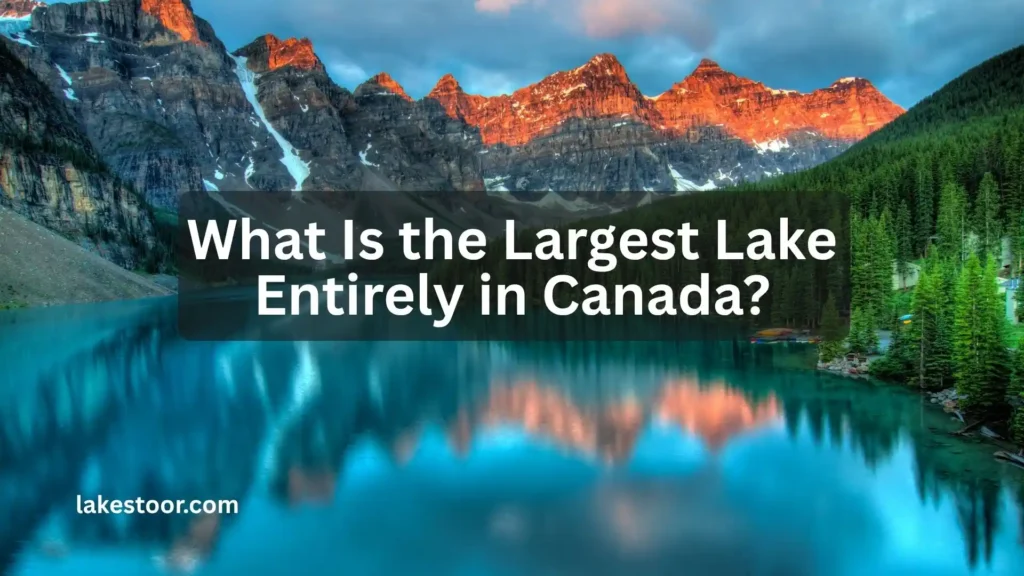
Great Bear Lake is the largest lake located entirely within Canada.
It is in the Northwest Territories and covers roughly 30,000 square kilometres.
The Government of Canada identifies Great Bear Lake as one of the world’s largest lakes and lists it at approximately 30,200–31,792 square kilometres depending on the source and measurement.
Great Bear Lake is also notable for its remote location and importance to northern ecosystems and communities.
What Is the Great Lakes System?
The Great Lakes are a group of five enormous freshwater lakes located along the Canada–United States border:
- Lake Superior
- Lake Michigan
- Lake Huron
- Lake Erie
- Lake Ontario
Four of the five Great Lakes border Canada. Lake Michigan is entirely within the United States.
The Great Lakes form one of the world’s most important freshwater systems. The Canada Water Agency describes the Great Lakes as one of the world’s largest freshwater ecosystems and notes that they contain about 20% of the planet’s surface fresh water.
They are important for:
- drinking water
- transportation
- fisheries
- wildlife
- recreation
- industry
- agriculture
- tourism
Why Are Canada’s Lakes Important?
Canada’s lakes are much more than geographical features. They support ecosystems, communities, economies, transportation, recreation, and freshwater resources.
Lakes provide habitats for fish, birds, aquatic plants, mammals, and countless microorganisms.
They also support human activities such as:
- fishing
- boating
- swimming
- tourism
- hydroelectric development
- transportation
- agriculture
- drinking-water supplies
The Government of Canada notes that lakes provide water resources, transportation opportunities, recreation, and important biodiversity and ecosystem functions.
How Much Fresh Water Do Canada’s Lakes Hold?
Canada’s freshwater resources are globally significant.
The Great Lakes alone contain a huge share of the world’s freshwater. Canadian government sources describe the Great Lakes as containing roughly 20% of the world’s surface freshwater, while some older government material uses a narrower “fresh lake water” measurement and gives 18%.
The difference illustrates why freshwater statistics should always be read in context: the percentage can change depending on whether researchers are referring to surface freshwater, freshwater in lakes, or a particular geographic boundary.
Is Every Lake in Canada Freshwater?
No.
Most of Canada’s lakes are freshwater, but “lake” does not automatically mean that the water is fresh. Salinity can vary among inland water bodies.
Canada’s lakes range from:
- clear freshwater mountain lakes
- enormous freshwater lakes
- shallow northern lakes
- small forest lakes
- wetlands and lake-like water bodies
- saline or mineral-rich inland waters
The overwhelming importance of Canada’s lake system, however, comes from its enormous freshwater resources.
Where Are Most of Canada’s Lakes Located?
Canada’s lakes are distributed across a huge portion of the country, but some regions are especially lake-rich.
Large concentrations occur across:
- Ontario
- Quebec
- Manitoba
- Saskatchewan
- Alberta
- British Columbia
- the Northwest Territories
- Yukon
- Nunavut
Northern Canada contains vast numbers of lakes, many of them in remote areas with few roads or permanent settlements.
Ontario is also particularly famous for its enormous number of lakes and extensive shoreline.
What Are the Largest Lakes in the World?
Several of the world’s largest lakes are located wholly or partly in Canada.
Here are some major examples:
| Lake | Approximate area | Location |
| Lake Superior | 82,100–83,300 km² | Canada & United States |
| Lake Huron | 59,500–59,800 km² | Canada & United States |
| Great Bear Lake | 30,200–31,792 km² | Canada |
| Great Slave Lake | 27,000–28,570 km² | Canada |
| Lake Erie | 25,657–25,720 km² | Canada & United States |
| Lake Winnipeg | 24,387–24,600 km² | Canada |
These figures come from Government of Canada data and are rounded because measurements can vary by source and methodology.
Canada vs. Finland: Which Has More Lakes?
Canada has more lakes overall.
Finland is famous for its huge concentration of lakes and its “Land of a Thousand Lakes” nickname, but Canada has a vastly larger number of lakes when the entire country is considered.
The comparison is also a good reminder that total number of lakes and lake density are different measurements.
A smaller country can have an extraordinary number of lakes per square kilometre without having more lakes in absolute terms than a much larger country.
Canada Has More Than Just Many Lakes
Canada’s distinction isn’t simply the number of lakes.
It also has:
- some of the world’s largest freshwater lakes
- huge lake-covered northern landscapes
- extensive freshwater ecosystems
- major international lake systems
- enormous freshwater resources
- thousands of kilometres of lake shoreline
The combination of lake quantity, lake size, and total lake area makes Canada particularly unusual.
Frequently Asked Questions
Which country has the most lakes in the world?
Canada has the most lakes in the world. Canadian government sources estimate that the country has more than 2 million lakes.
How many lakes are there in Canada?
Canada has more than 2 million lakes, although the exact number depends on the definition and minimum size used when counting lakes.
Is Finland the country with the most lakes?
No. Finland is famous as the “Land of a Thousand Lakes,” but Canada has more lakes overall.
What country has the most freshwater lakes?
Canada is the leading country when considering its enormous number and area of freshwater lakes.
What is Canada’s largest lake?
Lake Superior is the largest lake that Canada shares with another country and is the world’s largest freshwater lake by surface area. Great Bear Lake is the largest lake entirely within Canada.
How many lakes in Canada are over 100 km²?
The Government of Canada reports 563 lakes larger than 100 square kilometres.
Why does Canada have so many lakes?
The main reason is Canada’s glacial history. Large ice sheets reshaped the landscape during the Ice Age, creating countless depressions that later filled with water.
Does the United States have more lakes than Canada?
No. The United States has many lakes, particularly in states such as Alaska and Minnesota, but Canada has more lakes overall according to Canadian government sources.
Final Answer: Which Country Has the Most Lakes?
Canada has the most lakes in the world.
The country has more than 2 million lakes, according to Canadian government sources, and also has more lake area than any other country.
Canada’s extraordinary number of lakes is largely the result of its vast geography and glacial history. From the enormous Great Lakes to remote northern lakes, these water bodies play an important role in Canada’s environment, economy, wildlife, and communities.
So, if someone asks “Which country has the most lakes?”, the simplest accurate answer is:Canada — with more than 2 million lakes.

Hi, I’m Henry Ashford, a writer with a lifelong interest in lakes, landscapes, and the natural environment. I love exploring how lakes influence wildlife, local communities, tourism, and history. My goal is to create informative content that encourages readers to appreciate and protect freshwater environments.
Every article I write is based on careful research and presented in a straightforward, engaging style that makes learning enjoyable.
Books I’ve Written:
- Discovering the World’s Great Lakes
- Freshwater Landscapes: Stories from Around the Globe
 Charlotte Pembroke