
When most people hear the words underwater lakes, they imagine an ordinary lake somehow sitting beneath the ocean. Surprisingly, something remarkably similar does exist. Scientists and ocean explorers have discovered lake-like bodies of water on the seafloor, including extremely salty brine pools that can have distinct surfaces, shorelines, and even wave-like movements.
There is also another fascinating category of hidden lakes: subglacial lakes, which are bodies of liquid water trapped beneath enormous ice sheets. Antarctica contains many of these hidden lakes, including the famous Lake Vostok.
Although the term “underwater lake” is commonly used for these unusual environments, the scientific details are more interesting than the name suggests. Some are created by salt-rich fluids accumulating in seafloor depressions, while others exist beneath kilometers of ice.
This guide explains what underwater lakes are, how they form, where they are found, what lives in them, how scientists discover them, and why they are important to science.
What Are Underwater Lakes?
An underwater lake is a descriptive term for a relatively distinct body of water that exists beneath or within another aquatic or icy environment.
The term most commonly refers to deep-sea brine pools. These are extremely salty bodies of water that collect in depressions on the ocean floor. Because their salt concentration makes them considerably denser than ordinary seawater, the brine can remain pooled instead of immediately mixing with the water above it. NOAA describes these formations as underwater lakes and rivers.
Underwater lakes can therefore be divided into two broad categories:
- Deep-sea brine pools — dense, hypersaline water bodies on the seafloor
- Subglacial lakes — liquid-water bodies beneath glaciers and ice sheets
These two environments form in very different ways and should not be confused with one another.
Are Underwater Lakes Really Lakes?
The answer depends on how strictly the word lake is defined.
A conventional lake is an inland body of relatively still water surrounded by land. Deep-sea brine pools are not conventional lakes because they occur within an ocean basin.
However, some brine pools have characteristics that make the lake comparison surprisingly accurate. They can have:
- A distinct water surface
- A shoreline-like boundary
- A separate water chemistry
- A defined depression or basin
- Waves or disturbances on the brine surface
- Organisms living around their edges
NOAA has documented underwater lakes and rivers on the seafloor that can have surfaces, shorelines, and even waves.
So “underwater lake” is best treated as a descriptive term, while brine pool is the more precise term for many of the seafloor examples.
Underwater Lake Name
An underwater lake is usually not a traditional lake sitting beneath an ocean. The term is commonly used for dense pools of salty water, brine, or other fluids that collect on the seafloor and remain separated from the surrounding seawater.
These features are often called brine pools or underwater lakes because they can have a visible shoreline-like boundary and a different appearance from the seawater around them. Their high salt concentration makes the brine much denser than normal seawater, allowing it to settle into depressions on the ocean floor.
Some famous examples have been observed in the deep Gulf of Mexico. These brine pools can look like lakes surrounded by an underwater shoreline, even though they are actually part of the seafloor environment.
Brine Lake Underwater
A brine lake underwater is a pool of extremely salty water that forms on or near the ocean floor. Because the brine contains much more dissolved salt than normal seawater, it can become significantly denser.
Instead of immediately mixing with surrounding seawater, the dense brine can collect inside a seafloor depression. This creates a distinct boundary between the brine and ordinary ocean water.
Brine pools can also contain unusual chemical conditions. Their extreme salinity and low-oxygen environments can support specialized microorganisms while making the area difficult for many ordinary marine animals to inhabit.
These underwater brine environments are important to scientists because they provide natural laboratories for studying life under extreme conditions.
Underwater Lakes in the Ocean
Underwater lakes in the ocean are real in the sense that lake-like pools of dense fluids can exist on the seafloor. However, they are different from freshwater lakes found on land.
The best-known examples are deep-sea brine pools. They form when very salty water accumulates in a depression on the ocean floor. Because the brine is denser than the surrounding seawater, it can remain concentrated instead of rapidly mixing.
From a submersible or underwater camera, a large brine pool can appear surprisingly lake-like. It may have a distinct surface, boundaries, and even channels where brine flows across the seafloor.
Scientists study these environments because they combine unusual chemistry, pressure, temperature, and biology in one place.
How Do Underwater Lakes Work?
Underwater lakes work mainly because of density differences. A liquid containing a very high concentration of dissolved salts can become heavier than ordinary seawater.
When dense brine reaches a depression on the seafloor, gravity causes it to settle into the low area. Since the surrounding seawater is less dense, the two fluids do not instantly mix.
The result can be a relatively stable layer or pool of brine. Its boundary may remain visible because the two fluids have different physical and chemical properties.
The process is similar to how heavier liquids can settle beneath lighter liquids on land. The difference is that underwater brine pools exist under enormous pressure and in complex deep-ocean environments.
Do Underwater Lakes Exist?
Yes, lake-like bodies of dense brine exist on the ocean floor. Scientists generally describe many of them as brine pools rather than conventional lakes.
These pools have been observed in several deep-sea environments, including areas where salt deposits and geological activity create extremely salty fluids. Their high density allows them to settle into seafloor basins.
Calling them “underwater lakes” is useful for explaining their appearance, but it can also be misleading. They are not usually independent freshwater ecosystems enclosed by solid land like a normal terrestrial lake.
The most accurate description is often a dense brine pool or seafloor brine lake.
Underwater Lakes on Mars
The idea of underwater or subsurface lakes on Mars has attracted considerable scientific attention, but it needs an important qualification. Scientists have found evidence of ancient lakes and possible subsurface water or brines, but not confirmed Earth-like underwater lakes beneath a Martian ocean.
NASA’s Curiosity rover has found strong evidence that ancient Mars once contained long-lived lakes and streams. More recent studies have also investigated the possibility of liquid brines close to the Martian surface.
Radar observations from Mars’ south polar region once appeared to indicate possible underground lakes. However, later research has challenged that interpretation. In 2025, NASA reported that an enhanced radar study found that one feature previously suspected to be an underground lake was more likely a layer of rock and dust.
So, “underwater lakes on Mars” is best treated as a scientific research topic rather than a confirmed landscape feature.
How Are Underwater Lakes Formed?
Underwater lakes, especially deep-sea brine pools, can form when extremely salty fluids accumulate in depressions on the ocean floor.
One important source is the dissolution of ancient salt deposits. Geological processes can expose buried salt, and highly concentrated salty fluids can develop as water interacts with these deposits.
Because the resulting brine is denser than ordinary seawater, gravity pulls it downward. If the seafloor contains a basin or depression, the brine can collect there instead of immediately spreading through the surrounding ocean.
Over time, continued fluid movement can create a well-defined brine pool. Some pools can also develop channels through which dense brine flows across the seafloor.
Underwater Lakes Latest
Recent research continues to expand scientists’ understanding of water and brines in environments both on Earth and beyond it.
On Earth, deep-sea brine pools remain important research sites because they combine extreme salinity, unusual chemistry, and specialized microbial communities. These environments can help scientists understand how life survives under conditions very different from those at the ocean surface.
Mars remains an active area of research as well. A 2026 study published in Nature Communications reported evidence consistent with near-surface brines at meter-scale depths in parts of Mars, based on seasonal changes in seismic activity and thermal modeling. The researchers described present-day liquid water as not yet firmly confirmed.
At the same time, NASA’s recent radar research has weakened the case for at least one previously proposed Martian underground lake. This shows why claims about “underwater lakes on Mars” should be presented carefully as hypotheses and research findings rather than established facts.
Underwater Lakes and Waterfalls
Underwater lakes and waterfalls sound unusual, but both can occur because of differences in density and elevation on the seafloor.
Dense brine can flow downhill along the ocean floor in a way that resembles a river. If the brine moves over a steep underwater feature, the flow can resemble a waterfall.
There are also large-scale underwater waterfalls made from dense seawater. These flows can occur when water with different temperatures or salinities becomes denser and sinks through underwater channels or over seafloor slopes.
This means an underwater “waterfall” does not necessarily involve a separate lake falling over a cliff. It can be a dense water mass moving rapidly from a higher seafloor area toward a deeper one.
Underwater Lakes of Methane
Methane can exist in unusual forms beneath the ocean, but “underwater methane lakes” should not be confused with ordinary liquid lakes.
Methane occurs naturally in marine environments and can become trapped in sediments or form part of methane-rich deposits. Under particular pressure and temperature conditions, methane can also combine with water to form methane hydrates, which are ice-like crystalline structures.
On Earth, these methane-rich environments are important to geology and climate research. Scientists also investigate methane because it can be produced by both biological and geological processes.
Methane is also relevant to planetary science. NASA has detected methane near the surface of Mars, although scientists continue to investigate its source. Possible explanations include geological processes involving rocks, water, and heat; methane detection itself does not prove that life exists on Mars.
Lake Under the Sea
A lake under the sea is best understood as a dense fluid body that remains physically distinct from the surrounding seawater.
Deep-sea brine pools provide the clearest Earth examples. Their salt concentration makes them denser than normal seawater, so they settle into depressions on the seafloor.
Some of these pools are large enough to create recognizable lake-like landscapes. Submersibles have observed boundaries where the dense brine meets ordinary seawater, creating what looks like an underwater shoreline.
The unusual chemistry also makes these areas scientifically valuable. Microorganisms adapted to extreme salt concentrations can live around or within some brine environments, offering clues about survival in extreme habitats.
Salt Lakes in Ocean
Salt lakes in the ocean are generally better described as seafloor brine pools. They form when water becomes extremely concentrated with dissolved salts and becomes denser than the surrounding seawater.
Once this dense brine settles into a seafloor depression, it can remain there as a distinct body of fluid. The salt concentration can be so high that the brine behaves differently from normal seawater.
These underwater salt environments can contain steep chemical gradients between the brine and surrounding water. Such gradients provide energy and nutrients that specialized microorganisms can exploit.
For scientists, these pools are more than strange underwater scenery. They offer a way to study extreme ecosystems and the limits of life.
Amphibious Lake
“Amphibious lake” is not a standard scientific term for an underwater lake. The phrase can appear in informal descriptions, but it should not be treated as an established geological category.
If the intended meaning is a lake or water environment that supports both aquatic and land-connected ecosystems, terms such as wetland, lake ecosystem, coastal lagoon, or amphibious habitat may be more appropriate depending on the context.
If the phrase appears in an article about underwater lakes, it is useful to explain the terminology rather than presenting “amphibious lake” as a recognized type of deep-sea lake.
Lake at the Bottom of the Ocean
A lake at the bottom of the ocean can exist in the form of a brine pool. These pools are among the most fascinating examples of unusual environments on Earth’s seafloor.
Their dense, salty water settles into low areas because it is heavier than ordinary seawater. The resulting pool can have a visible boundary and may even develop streams or channels as brine moves across the surrounding seafloor.
The environment inside a brine pool can be extremely salty and oxygen-poor. Yet some microorganisms have adapted to these harsh conditions.
This is why scientists are interested in bottom-of-the-ocean lakes. They provide natural examples of how fluids behave under extreme conditions and how life can survive in environments that seem hostile to most organisms.
How Do Underwater Lakes Form?
The formation of deep-sea underwater lakes is closely connected to geology, salt deposits, and water density.
1. Ancient Salt Deposits
In areas such as the Gulf of Mexico, thick layers of salt were deposited by ancient seas and later buried beneath sediments.
These underground salt deposits can interact with water moving through geological formations.
2. Seawater Dissolves the Salt
Water can move through the sediments and come into contact with buried salt. As the salt dissolves, the resulting water becomes extremely concentrated with dissolved salts.
3. Dense Brine Moves Toward the Seafloor
The highly salty water becomes denser than ordinary seawater. It can migrate upward through geological structures and emerge through seeps on the seafloor. Research on Gulf brine systems describes this process as fluids dissolving buried salt and producing dense brine that can accumulate at the seafloor.
4. Brine Collects in a Depression
If the dense brine reaches a low area of the seafloor, gravity causes it to remain there.
Instead of rapidly mixing with the surrounding seawater, it forms a separate pool.
That is how a lake-like body can exist inside an ocean.
Why Doesn’t an Underwater Lake Mix With the Ocean?
The main reason is density.
Ordinary seawater contains dissolved salts, but brine pools can contain dramatically higher concentrations.
More dissolved salt means greater density. The extremely salty brine therefore sinks and remains beneath the less-dense seawater.
Think of it as a natural density boundary. The two water masses can interact at their interface, but they do not instantly become one uniform body of water.
The NEOM Brine Pools in the Gulf of Aqaba provide a striking example. Researchers measured normal seawater above the pool and found that salinity increased sharply at the brine interface, reaching a measured brine salinity of about 160 PSU. Dissolved oxygen also dropped dramatically inside the brine.
Where Are Underwater Lakes Found?
Deep-sea brine pools have been documented in several regions, particularly areas with unusual geological histories and buried salt deposits.
Important locations include:
- Gulf of Mexico
- Red Sea
- Gulf of Aqaba
- Mediterranean region
Research indicates that deep-sea brine pools are relatively rare and have been documented in only a limited number of ocean basins.
Subglacial lakes are found beneath ice sheets, especially in Antarctica.
Underwater Lakes in the Gulf of Mexico
The Gulf of Mexico is one of the best-known places for underwater lakes and rivers.
NOAA explains that these formations can develop when seawater moves through thick underground salt layers. The salt dissolves into the water, increasing its density. The dense water can then collect in depressions on the seafloor.
Some of these underwater lakes are surrounded by communities of organisms that have adapted to the unusual chemical conditions.
This makes the Gulf of Mexico brine pools important not only geologically but also biologically.
The NEOM Brine Pools in the Gulf of Aqaba
One of the more remarkable examples was reported in the Gulf of Aqaba, part of the Red Sea system.
Researchers discovered the NEOM Brine Pools at a depth of approximately 1,770 meters. The main pool is about 260 meters long and 70 meters wide, covering roughly 10,000 square meters. Its brine layer reaches approximately 6 meters in thickness at the center.
Three smaller pools were found nearby.
The discovery was particularly important because it represented the first reported deep-sea brine-pool system in the Gulf of Aqaba.
The pool also provides an extraordinary geological archive. Researchers found sedimentary layers preserving evidence of events including flooding, seismic activity, and tsunami-related deposits. The main pool’s sediment record extends back at least about 1,200 years.
What Do Underwater Lakes Look Like?
One of the most surprising facts about underwater lakes is that some genuinely look like lakes.
The interface between dense brine and ordinary seawater can appear as a distinct surface. Because the brine has a different optical and physical character, the boundary can be visible to remotely operated vehicles.
Some underwater brine pools even have areas that resemble beaches or shorelines.
During research on the NEOM Brine Pools, scientists identified zones around the pool’s edge that behaved somewhat like a beach and swash zone. Small disturbances could move brine over these areas.
Also Check This Post:Pictures of Lakes: Beautiful Lake Images, Scenic Views, Wallpapers & Photography Guide
Can Underwater Lakes Have Waves?
Yes, at least some deep-sea brine pools can experience wave-like disturbances.
These are not ocean waves caused by wind blowing across an exposed surface. Instead, movements can be produced by disturbances around the pool, including currents, animals, sediment movement, or activity caused by exploration equipment.
NOAA notes that some underwater lakes can have surfaces and even waves. Researchers studying the NEOM Brine Pools also observed that small disturbances could affect the brine surface and surrounding zones.
This is one of the reasons underwater lakes are so fascinating: they can resemble familiar landscapes while existing in a completely different environment.
How Deep Are Underwater Lakes?
There is no single depth because underwater lakes occur in different geological environments.
Deep-sea brine pools may lie hundreds or thousands of meters below the ocean surface. For example, the NEOM Brine Pools are located at approximately 1,770 meters depth.
The depth of the brine itself can be much smaller than the depth of the surrounding ocean. In the NEOM main pool, the brine was measured at up to approximately 6 meters thick.
Subglacial lakes are different. They can be located beneath several kilometers of ice.
How Large Are Underwater Lakes?
Their sizes vary enormously.
Some deep-sea brine pools are only hundreds of square meters, while others can cover much larger areas. Research indicates that known deep-sea brine pools range from relatively small pools to areas reaching several square kilometers.
The NEOM main pool covers approximately 10,000 square meters.
Subglacial lakes can be vastly larger.
Lake Vostok in Antarctica, for example, has been estimated to cover roughly 13,000–14,000 square kilometers, depending on the study and measurement method. Scientific estimates have also placed its water volume in the thousands of cubic kilometers.
Therefore, comparing the size of a Gulf brine pool directly with Lake Vostok would be misleading because they are fundamentally different types of hidden water bodies.
What Lives in Underwater Lakes?
Deep-sea brine pools are extreme environments.
Inside these pools, scientists can encounter conditions such as:
- Extremely high salinity
- Very low oxygen or complete anoxia
- High pressure
- Darkness
- Unusual chemical conditions
- Low pH in some environments
Despite these conditions, life can exist around the pools.
Microorganisms
Microbes are particularly important.
Some microorganisms can tolerate extreme salinity and oxygen-poor conditions. These organisms are known as extremophiles or are studied as examples of life adapted to extreme environments.
Mussels
Some brine-pool ecosystems support large communities of mussels around their edges.
These animals do not depend on sunlight in the way plants and surface ecosystems do. Instead, microbial communities can convert chemicals such as methane into usable energy, forming the foundation of unusual deep-sea food webs.
Life at the Boundary
The transition between normal seawater and hypersaline brine can be especially biologically interesting.
Researchers studying the NEOM pools documented microbial communities concentrated around the brine interface.
Are Underwater Lakes Freshwater or Saltwater?
Most famous deep-sea underwater lakes are not freshwater.
They are usually hypersaline brine pools, meaning their water contains much more dissolved salt than ordinary seawater.
This is one of the biggest differences between underwater brine lakes and conventional lakes.
However, subglacial lakes are different. Their water can be much less salty and is generally associated with melting and freezing processes beneath ice sheets.
So the answer depends on what type of underwater lake you mean:
| Type | Typical water characteristics |
| Deep-sea brine pool | Extremely salty |
| Subglacial lake | Generally much less saline |
| Ordinary surface lake | Usually freshwater, but exceptions exist |
What Is Lake Vostok?
Lake Vostok is one of Earth’s most famous hidden lakes, but it should technically be described as a subglacial lake, not a deep-sea brine pool.
It is located beneath the East Antarctic Ice Sheet.
Scientific investigations using radar, satellite observations, gravity data, and other geophysical techniques have revealed the size and shape of the lake beneath the ice. Estimates vary, but Lake Vostok covers roughly 13,000–14,000 square kilometers and contains thousands of cubic kilometers of water.
The lake lies beneath several kilometers of Antarctic ice.
How Can Water Stay Liquid Under Ice?
Several processes can contribute to maintaining liquid water beneath a thick ice sheet.
These include:
- Pressure from the overlying ice
- Geothermal heat from Earth’s interior
- Melting at the base of the ice
- Water circulation beneath the ice
Lake Vostok therefore demonstrates that liquid water can persist in an environment that is completely hidden from the surface.
Underwater Lakes vs. Subglacial Lakes
The two concepts are often confused, but they are very different.
| Feature | Deep-Sea Brine Pools | Subglacial Lakes |
| Location | Ocean seafloor | Beneath ice |
| Famous example | Gulf of Mexico brine pools | Lake Vostok |
| Water | Hypersaline | Generally much less saline |
| Main cause | Salt dissolution and dense brine accumulation | Ice melting, pressure, and geothermal processes |
| Environment | Deep ocean | Beneath glaciers or ice sheets |
| Main scientific fields | Oceanography, geology, microbiology | Glaciology, geology, climate science |
| Surface | Brine-seawater interface | Ice-water boundary |
This distinction is important when researching the keyword underwater lakes, because searchers may be interested in either deep-ocean brine pools or hidden lakes beneath ice.
Also Check This Post:Lakes in Illinois: 20 Best Lakes to Visit, Swim, Fish, and Explore
How Do Scientists Discover Underwater Lakes?
Scientists cannot simply look across the ocean and see these lakes from the surface.
Instead, they use specialized technologies.
Multibeam Sonar
Multibeam sonar maps the shape of the seafloor. It can reveal depressions, geological structures, and unusual features.
Subsea Imaging
Researchers can use high-frequency imaging sonar and cameras mounted on remotely operated vehicles to identify and map brine pools.
In the NEOM study, researchers used an ROV-mounted imaging sonar to help identify the pool and navigate around it.
CTD Instruments
A CTD measures conductivity, temperature, and depth. Conductivity provides information about salinity.
Scientists can lower these instruments through the water column and detect sudden changes at the brine-seawater interface.
Water Sampling
Researchers can collect samples from above, at, and below the boundary to determine:
- Salinity
- Temperature
- Oxygen levels
- Chemical composition
- Microbial communities
Sediment Cores
Sediment cores can reveal environmental history.
For example, scientists studying the NEOM Brine Pools found evidence preserved in sediment layers that can help reconstruct past flooding, seismic events, and tsunami activity.
Why Are Underwater Lakes Important?
Underwater lakes are more than strange natural curiosities. They provide scientists with natural laboratories for studying several major questions.
1. They Help Scientists Study Extreme Life
The high salinity, low oxygen, darkness, and unusual chemistry of brine pools create conditions close to the limits of habitability.
Researchers can study organisms that survive there to understand how life adapts to extreme environments.
2. They Preserve Geological History
Because anoxic brine can prevent many organisms from disturbing sediments, sediment layers may remain unusually well preserved.
The NEOM Brine Pool research showed that these sediments can preserve evidence of natural events over long periods.
3. They Improve Our Understanding of Earth’s Geology
Brine pools are closely connected to geological structures, salt deposits, faults, and fluid movement beneath the seafloor.
Studying them can therefore reveal information about processes happening deep below the ocean floor.
4. They Help Researchers Think About Life Beyond Earth
Extreme environments on Earth are useful analogues for scientists considering whether life could exist in harsh environments elsewhere.
Subglacial environments are particularly interesting because they demonstrate that liquid water and potentially habitable conditions can exist beneath thick ice.
Are Underwater Lakes Dangerous?
For most humans, the main danger is not the brine itself but the extreme environment where these lakes occur.
Deep-sea brine pools can be located at great depths, where there is:
- Enormous water pressure
- No sunlight
- Very low temperatures in some regions
- Difficult access
- Potentially toxic or oxygen-poor water
The brine can also be harmful or lethal to many marine organisms that enter it because of its extreme chemistry.
However, underwater lakes are not naturally “dangerous lakes” in the way the phrase might suggest. They are simply environments that are extremely difficult for humans to access and survive in without specialized equipment.
Can Fish Live in Underwater Lakes?
Most ordinary fish are poorly suited to the conditions inside hypersaline brine pools.
The combination of extreme salinity and oxygen deficiency can make the interior of a brine pool inhospitable to many animals.
However, the edges of these pools can support surprisingly rich ecosystems.
Microbes and specialized organisms can live near the boundary where normal seawater interacts with brine. Some deep-sea animals also benefit from microbial food webs associated with these environments.
Are Underwater Lakes Completely Still?
No.
Although brine pools can remain remarkably stable because of density differences, they are not necessarily motionless.
Water can enter the pool from geological sources, brine can move across the seafloor, and disturbances can affect the brine surface.
Researchers studying the NEOM Brine Pools observed evidence that even minor disturbances could inundate areas around the pool’s edge.
Are There Underwater Rivers Too?
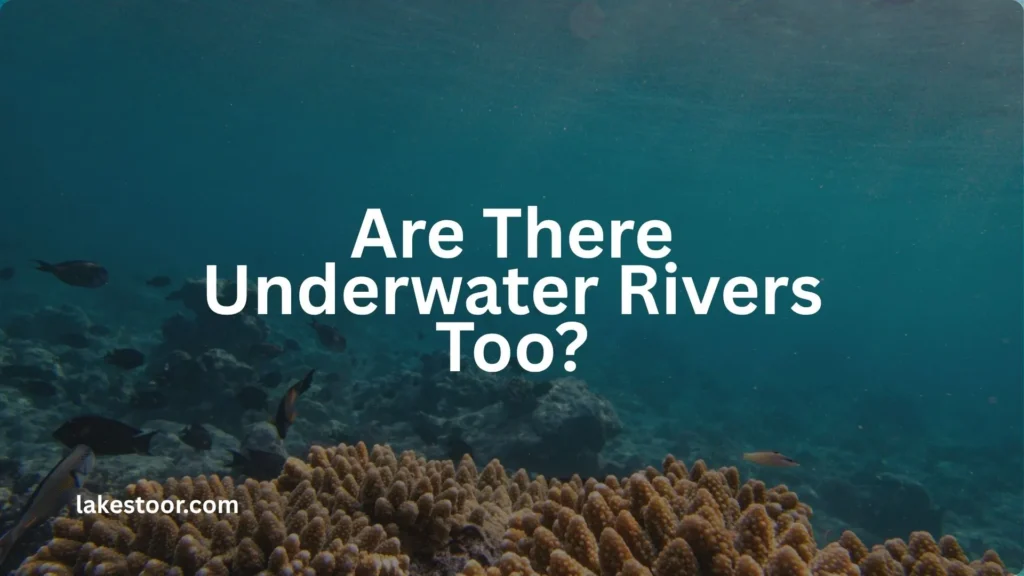
Yes.
Some dense brine can flow across the seafloor in a way that resembles a river.
NOAA describes underwater lakes and rivers in the Gulf of Mexico, explaining that dense salt-rich water can move through seafloor depressions rather than mixing immediately with ordinary seawater.
This means the seafloor can contain landscapes that surprisingly resemble familiar features on land:
- Lakes
- Rivers
- Valleys
- Depressions
- Shoreline-like boundaries
The major difference is that all of this occurs beneath the ocean.
Underwater Lakes and the Search for Extreme Life
One of the most exciting scientific questions surrounding underwater lakes is the limit of life.
Deep-sea brine pools can be extremely salty, oxygen-poor, dark, and chemically unusual. Yet microbial communities can survive in or around these environments.
Scientists study such organisms to understand:
- How cells tolerate extreme salinity
- How microbes survive without oxygen
- How organisms obtain energy without sunlight
- How ecosystems develop in chemically extreme environments
- What conditions might allow life to exist elsewhere
This does not prove that life exists beyond Earth, but studying Earth’s extreme environments helps researchers understand what forms of habitability are physically possible.
Interesting Facts About Underwater Lakes
Here are some of the most surprising facts about underwater lakes:
- Some underwater lakes have recognizable surfaces. Their brine-seawater boundaries can look remarkably lake-like.
- Some can have wave-like disturbances. The movement is not the same as wind-driven waves on a normal lake.
- Many deep-sea examples are extremely salty.
- Some contain almost no oxygen.
- Life can exist around their boundaries.
- Ancient salt deposits can help create them.
- Sediments beneath some brine pools preserve records of past geological events.
- Some underwater brine pools are only hundreds of square meters, while others reach much larger areas.
- Lake Vostok is a completely different type of hidden lake because it lies beneath Antarctic ice.
- Scientists use robots, sonar, sensors, and sediment cores to investigate these environments.
Frequently Asked Questions About Underwater Lakes
Do underwater lakes really exist?
Yes. Deep-sea brine pools are real bodies of dense, hypersaline water that can accumulate in depressions on the seafloor and remain distinct from surrounding seawater. NOAA specifically describes some of these formations as underwater lakes and rivers.
What are underwater lakes called?
The most precise scientific term for many seafloor examples is deep-sea brine pool or brine lake.
Are underwater lakes freshwater?
Most deep-sea underwater lakes are not freshwater. They are hypersaline brine pools. Subglacial lakes beneath ice sheets are different and can contain much less salty water.
Can underwater lakes have waves?
Yes. Some deep-sea brine pools can experience wave-like disturbances at their surfaces. These are caused by underwater processes rather than ordinary wind blowing across the surface.
Where is the largest underwater lake?
There is no universally accepted “largest underwater lake” because the term includes different types of environments. Lake Vostok is among the largest known hidden subglacial lakes, while deep-sea brine pools are generally much smaller.
What is the most famous underwater lake?
For deep-sea examples, the brine pools of the Gulf of Mexico are among the best-known. For hidden lakes beneath ice, Lake Vostok is one of the most famous examples.
Can humans swim in underwater lakes?
No. Deep-sea brine pools are generally located in environments where human swimming is impossible because of extreme depth and pressure. Their water chemistry can also be hazardous.
Do animals live in underwater lakes?
Some organisms live around deep-sea brine pools, especially microorganisms and animals associated with the edges. However, the highly saline, oxygen-poor interior can be extremely hostile to most animals.
How do scientists find underwater lakes?
Scientists use tools such as sonar, remotely operated vehicles, CTD instruments, water samplers, sediment cores, and other geophysical techniques to locate and study them.
Why are underwater lakes important?
They provide information about ocean geology, salt deposits, extreme environments, microbial life, natural disasters, sedimentary history, and the limits of habitability.
Underwater Lakes vs. Ordinary Lakes
The biggest difference is their environment.
An ordinary lake is generally exposed to the atmosphere and surrounded by land. An underwater brine lake is submerged beneath seawater and often contains water with dramatically different chemistry.
An ordinary lake may receive sunlight, support photosynthetic plants, and experience seasonal changes at the surface. A deep-sea brine pool exists in darkness and may depend on chemical energy and microorganisms instead.
Yet both can have surprisingly similar physical features, including a basin, a distinct water body, and boundaries between the lake water and its surroundings.
Why Underwater Lakes Matter to Our Understanding of Earth
Underwater lakes demonstrate that Earth’s environments are far more diverse than what we see on the surface.
The ocean floor is not simply a flat layer covered by seawater. It contains mountains, valleys, faults, sediments, volcanic structures, salt formations, seeps, lakes, and even river-like flows.
Deep-sea brine pools reveal how geological processes can create highly unusual water bodies. Their sediments can preserve evidence of environmental and geological events, while their microbial ecosystems show how life can survive under extreme conditions.
Subglacial lakes reveal something equally remarkable: liquid water can persist beneath kilometers of Antarctic ice.
Together, these discoveries expand our understanding of where water can exist and where life might potentially survive.
Final Thoughts
Underwater lakes are real, but the phrase describes several different types of hidden water environments. The most recognizable examples are deep-sea brine pools, where extremely salty, dense water settles into depressions on the ocean floor. Some have distinct surfaces, shoreline-like edges, and wave-like disturbances, making them surprisingly similar to lakes on land.
Other hidden lakes, such as Lake Vostok, exist beneath enormous Antarctic ice sheets rather than beneath the ocean.
These environments are scientifically valuable because they reveal unusual geological processes, preserve records of Earth’s past, and support organisms capable of surviving extreme conditions.
The deeper scientists explore Earth’s oceans and ice sheets, the clearer it becomes that a “lake” does not always need to be on the surface. Some of the planet’s most fascinating lakes are hidden in places that humans cannot easily see—or reach.
Also Check This Post:Lakes in Switzerland: 15 Best Lakes to Visit, Things to Do & Travel Tips

Hi, I’m Henry Ashford, a writer with a lifelong interest in lakes, landscapes, and the natural environment. I love exploring how lakes influence wildlife, local communities, tourism, and history. My goal is to create informative content that encourages readers to appreciate and protect freshwater environments.
Every article I write is based on careful research and presented in a straightforward, engaging style that makes learning enjoyable.
Books I’ve Written:
- Discovering the World’s Great Lakes
- Freshwater Landscapes: Stories from Around the Globe
 Oliver Whitmore
 Charlotte Pembroke